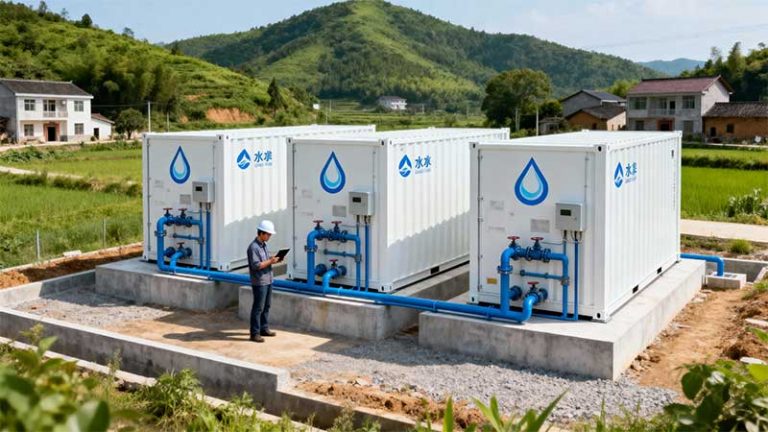

A second container needs more than a place beside the first. Your project team also needs to know how much extra water will reach the delivery point, including during cleaning or a shutdown of one treatment train. For a containerised water treatment plant, expansion brings the shared intake, tanks and operating sequence into the design discussion. We recommend settling those interfaces before committing to another treatment unit.
Net supply defines the next stage
Your expansion brief should name the delivery point. A flow measured at a membrane outlet answers a different question from the volume available to users after internal consumption. Put the required daily volume and peak demand beside the operating hours, then state the supply needed while one train is unavailable. A train is a group of treatment equipment operated as a unit.
Backwashing consumes some of the filtered water. The US EPA’s 2005 Membrane Filtration Guidance Manual describes a typical productivity reduction of 5–10% from this use of filtrate. Treat that range as context for the water balance, not a deduction to apply automatically to every quotation. The actual allowance belongs to the selected process and operating cycle.
Maintenance deserves its own operating case. The same guidance explains that design capacity may represent a maximum without allowing for a unit taken out of service. Ask for a separate calculation for that condition. A spare train, storage provision and a lower temporary supply target are different design choices; the project brief should identify which choice is acceptable.
Shared facilities need room to grow
Shared equipment defines the boundary of the expansion. For an ultrafiltration membrane water treatment project, follow the proposed additional flow from the intake through to the delivery connection. The new container may have its own pumps and valves, while the intake or delivery main remains common to both stages. Each shared item needs an expanded-duty check on the interface drawing.
Backwash creates a different operating condition from filtration. Water must be available for the wash while the remaining trains continue their assigned duty, and the discharge needs a defined route. The EPA guidance describes staggered backwashing to limit simultaneous washing. The design review should therefore cover the wash-event flow and volume, alongside the coordination allowed between trains.
Power and access belong on the same interface review. Have the electrical designer check the expanded load and starting sequence. On the layout, retain space to remove a membrane module and reach isolation valves after the next container arrives. These are project checks, so record the dimensions and electrical duties for your actual equipment instead of copying an allowance from a different plant.
Component selection stays tied to operating conditions
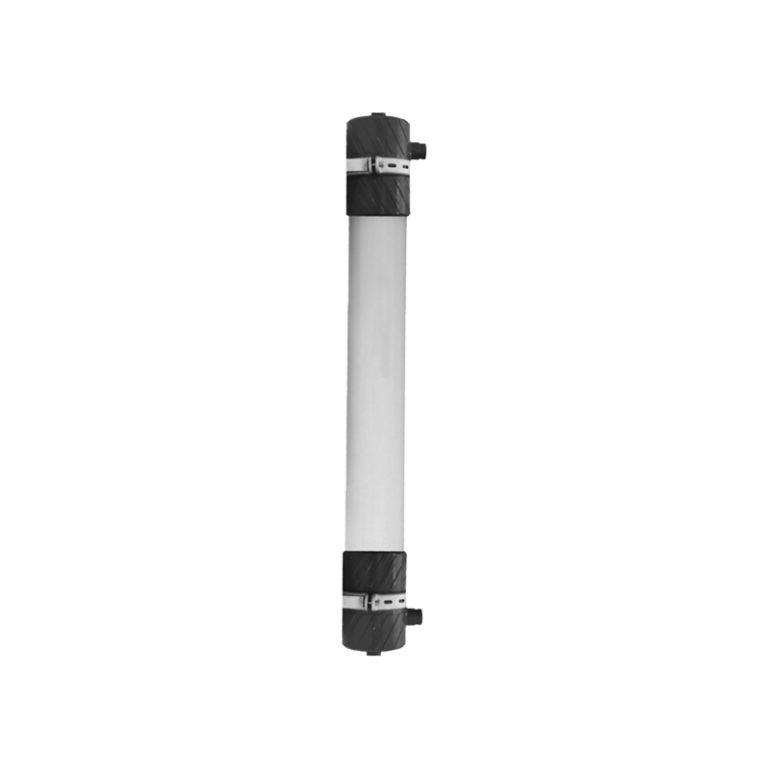
Membrane selection comes after the required operating duty is clear. Our HOSONWATER LW components can be integrated into standardized or customized LGW ultrafiltration equipment. When evaluating a hollow fiber ultrafiltration membrane module for an expansion, keep the component data attached to its model and distinguish it from the net output of the assembled plant.
Two LW component examples illustrate the data available for this review. The flow ranges below are component figures, expressed in cubic metres per hour. Wet handling weight is approximate.
|
LW component |
Effective membrane area |
Component flow range |
Wet handling weight |
|---|---|---|---|
|
LW2-0960-F |
56 m² |
1.6–8.0 m³/h |
Approximately 50 kg |
|
LW2-0980-F |
77 m² |
2.2–11.0 m³/h |
Approximately 60 kg |
Component data narrows the selection but leaves an operating decision to be made. The ranges in the table do not identify the selected duty within them. Feed-water quality affects membrane flux, as the EPA guidance explains. The plant calculation needs that chosen duty, its water conditions and the allowance for cleaning before module quantities can be settled.
A mixed equipment schedule makes model identification especially useful. An expansion may introduce a component that differs from the original installation. Record that difference at each installed position, including connections and handling requirements, then carry it into maintenance instructions. A larger membrane area alone is insufficient information for a substitution decision.
Several treatment trains need an agreed operating sequence
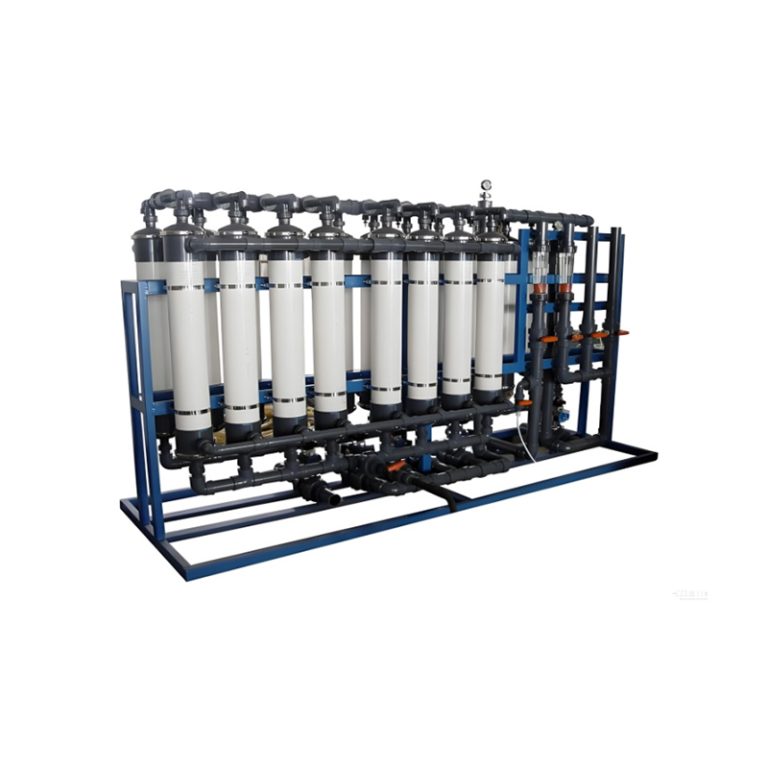
Train coordination becomes a separate design task as a modular water treatment plant grows. Normal filtration, a backwash request and the return of an isolated train are different operating states. A useful sequence description shows the initiating signal and the conditions required for each transition. Your operators need the corresponding local procedure as well as the automatic sequence.
Our smart-water platform displays process diagrams with real-time water parameters and equipment or valve status. It also supports configurable threshold alerts by SMS, email or app notification. In your review of water treatment control systems, distinguish these display and notification functions from the project-specific logic that starts pumps, moves valves or inhibits a wash cycle.
An alarm leaves an operating question to resolve. A notification can tell your team that a threshold was crossed; the agreed response still needs to identify the local checks and any automatic action. Include loss of communications in that review. Demonstrate the specified local behavior during commissioning so that a remote message is not mistaken for confirmation of a process response.
Expansion should be demonstrated at the delivery point
A staged commissioning plan makes the proposed operating cases testable. Agree how the new train will be isolated during connection work, which measurements will be recorded and what water conditions apply to the test. Include a run with the agreed maintenance configuration. Compare the recorded delivery with the net-supply requirement established at the beginning.
Your expansion decision should therefore rest on a connected design: a defined supply duty, checked shared facilities, model-specific component selection and an operating sequence that can be demonstrated. Bring the current layout and operating records into the discussion with HOSONWATER so that the next-stage requirements are concrete.
FAQ (Pertanyaan umum)
Does every container represent one treatment train?
Use the process diagram to establish that relationship. Specify which equipment operates together and can be isolated together; the enclosure count alone should not define the operating groups in your project documents.
Should the expansion use the original raw-water analysis?
Check whether that analysis still describes the intended supply. Include recent operating records and seasonal samples in the design review, particularly if the intake or source has changed.
Can the new train use a different membrane model?
Treat a model change as a design review. Compare the required operating duty, connections and cleaning requirements, and document the approved configuration before ordering replacement stock.
How should spare capacity be described?
State the unavailable equipment, permitted operating conditions and required supply duration. Request the corresponding net delivery calculation instead of relying on an unspecified percentage of spare capacity.
What should the final expansion records contain?
Keep the updated process diagram, equipment schedule, control sequence and commissioning results together. Record the tested water conditions and delivery point so your operating team can interpret the results later.