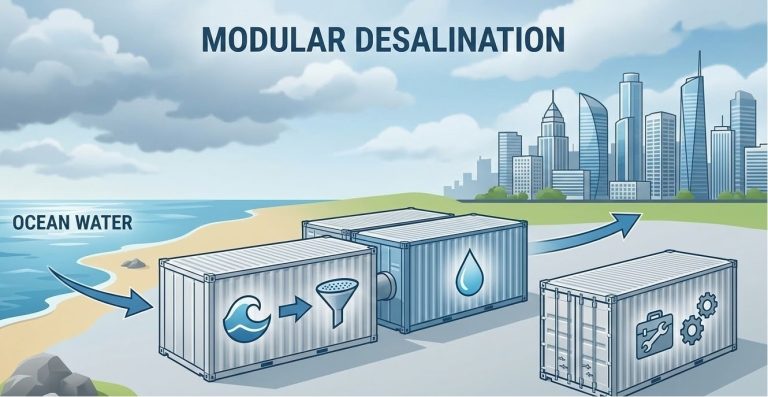

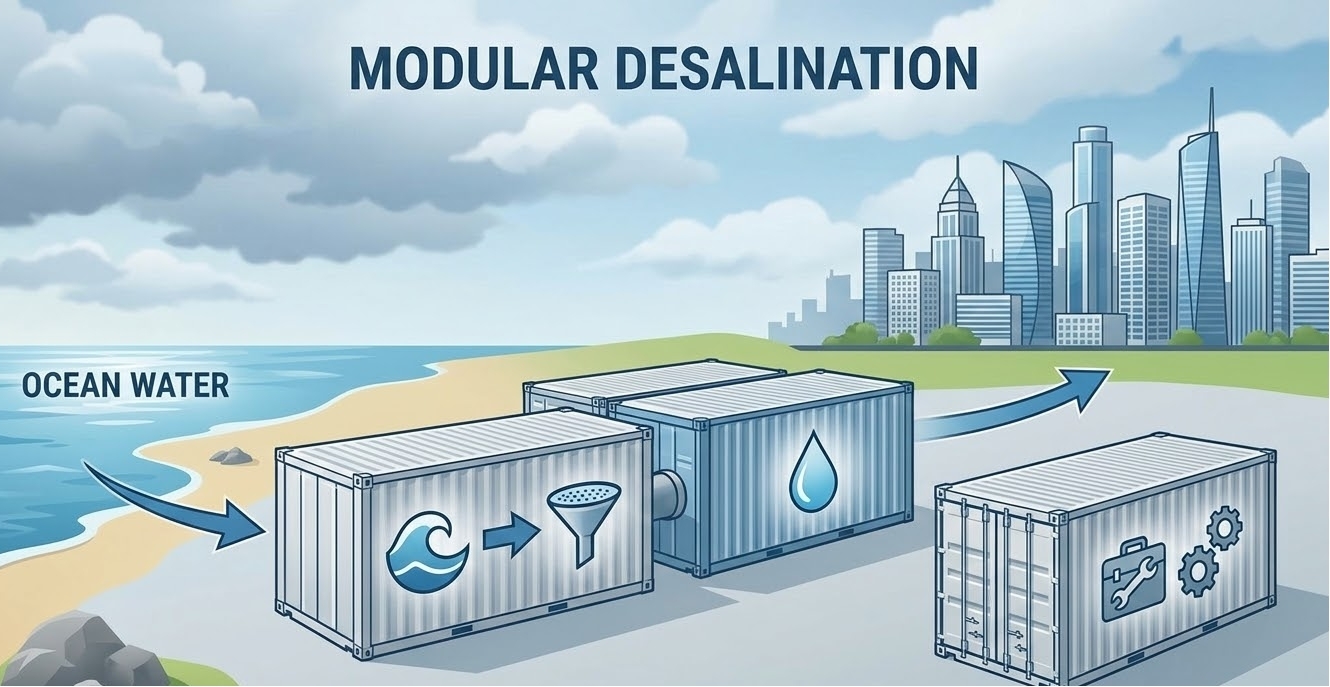
The global lack of fresh water appears closer than before. It presents a serious issue today. Conventional large water plants struggle to keep pace with rapid city growth and shifting climate patterns. For that reason, the sector seeks out more adaptable, dependable, and straightforward-to-deploy alternatives. At the head of this transition is modular desalination. This approach to producing water reshapes desalination and water treatment.
What is a Modular Desalination Plant and How Does It Work?
A modular desalination plant operates as a full water production setup. Within it, vital components, from intake pumps to filtration systems, are installed on a basic base called a skid or within a standard freight container. These stand out from standard plants. The typical ones call for extended building work directly at the location. By contrast, these factory-assembled units arrive set for swift activation.
The core method powering these units relies on Reverse Osmosis (RO). It functions by pushing seawater through dedicated membranes under strong pressure. Through this, it eliminates salts, microbes, and various contaminants. Based on the proven techniques of HOSON, a carefully organized system usually proceeds along a straightforward series of phases. To start, pre-treatment takes place. It employs equipment like Ultrafiltration (UF) or multi-layer filters to clear away drifting particles and tiny life forms. Following that, high-pressure pumps engage. These originate from solid manufacturers like Italy AR brand or Germany SPECK brand, and they aim to surpass the water’s inherent resistance. Then, the RO membrane stage handles the primary purification.
| Особенность
| Industrial Modular Specification (e.g., FSHB-320) |
| Ежедневная мощность | 320 Tons Per Day (TPD) |
| Коэффициент отклонения соли | 99,2% |
| Feed Water Limit | TDS ≤ 40 000 ppm |
| Потребление энергии | ~75 kWh |
| Скорость восстановления системы | 35% |
Why is Modular Desalination the Best Choice for Remote Locations?
In places like islands, ocean platforms, and distant camps, water functions as an essential resource. modular desalination brings tangible advantages that rigid installations cannot provide.
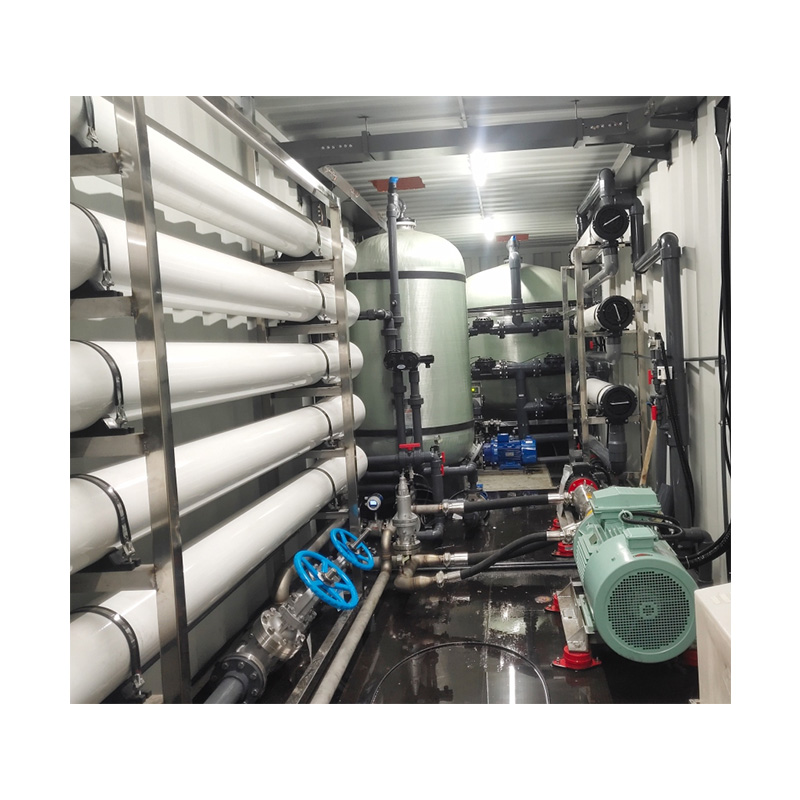
- Rapid Deployment: Modules are fully assembled and factory-tested. Once they arrive at the site, they only require power and pipe connections, reducing commissioning time from months to weeks.
- Space Optimization: In environments like offshore oil rigs where deck space is at a premium, a compact modular desalination plant(e.g., 12m x 2.3m) provides maximum output within a minimal footprint.
- Extreme Adaptability: These systems can function in tough settings. They endure temperatures from 5°C to 45°C.
- Operational Resilience: The 2-7-24 rapid response system makes sure that technical help reaches even distant spots. In addition, it fixes big problems within 24 to 72 hours.
How Does Modular Technology Optimize Energy and Costs?
Many people assume that desalination and water treatment requires vast expenses. Nevertheless, modern modular configurations counter that view with intelligent assembly and efficiency-focused techniques.
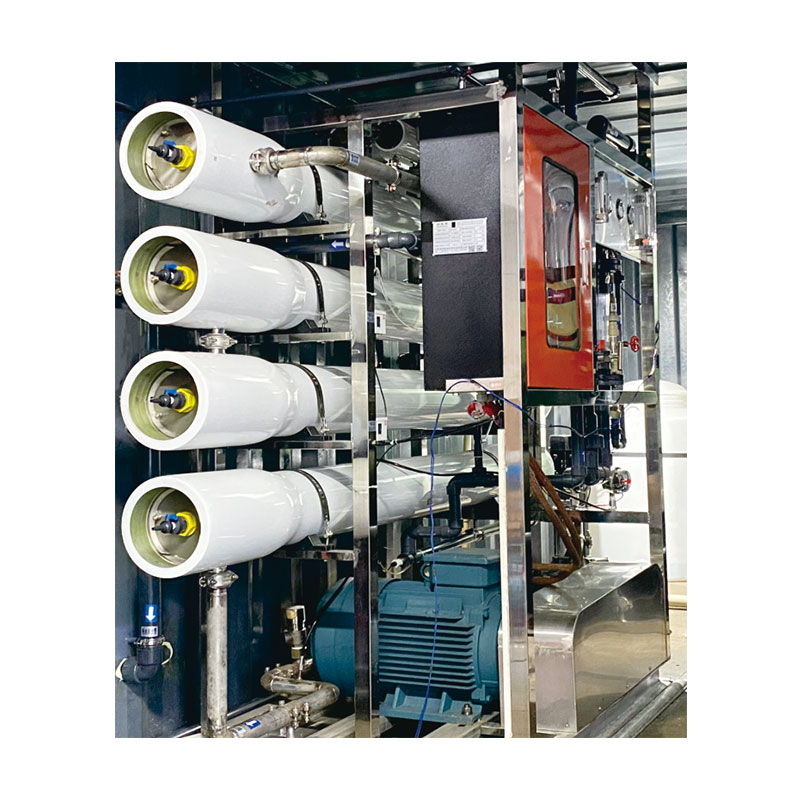
These configurations incorporate Energy Recovery Devices (ERD). These devices capture the energy from the rejected brine. Afterward, they channel it to assist the incoming seawater stream. Consequently, energy needs fall considerably. As an illustration, envision a robust module that generates 320 tons of water per day. It operates using merely 75kWh. Such a design promotes consistent operation and minimizes energy waste.
When considering the complete operational expenses, termed Total Cost of Ownership (TCO), specific aspects emerge clearly.
- Modular Modularity allows us to minimise the amount of Onsite construction work required. The foundation of the system allows for Reduced Civil Works in that there is no need for mass concrete foundations or permanent structures.Scalability: The system can be expanded as required by adding an additional module, rather than having to expand the existing structure to meet growing water demands. Using an automated control system based on a PLC makes it possible to remotely monitor the system thereby avoiding the need for on-site presence of highly qualified Process Engineers on a permanent basis.
What are the Key Applications for Desalination and Water Treatment Modules?
The versatile structure of modular desalination permits it to serve diverse sectors. Beginning with a compact portable model for difficult regions to an extensive collection of skids for municipal water supplies, the basic principle stays constant. This diversity enables it to address varied demands. Therefore, it provides pure water precisely where it matters most.
| Model Type | Primary Use Case | Portability |
| Portable Suitcase (0.5 TPD) | Emergency/Survival, Small Boats | High (Hand-carried) |
| Skid-Mounted (10-100 TPD) | Resorts, Remote Research Bases | Medium (Truck-mounted) |
| Containerized (200-2000 TPD) | Municipal Supply, Large Factories | Low (Shipping Container) |
Case Study: Solving Water Scarcity in Remote Environments
One evident victory in desalination and water treatment happened at a facility for 60 inhabitants in an isolated area. The primary worry focused on a close-by water source. It grew turbid, rising to 80 NTU, amid strong rains. To resolve this, the group set up a modular Ultrafiltration (UF) unit alongside Reverse Osmosis. That combination yielded a steady 9 tons of potable water every day. Owing to the modular design, it continued to perform at optimal levels even with changing weather. Ultimately, it showed that a modular desalination plant serves as the leading trustworthy selection for essential tasks in secluded spots.
Conclusion: Embracing the Future of Decentralized Water
In closing, modular desalination surpasses mere instruments. It delivers a practical remedy for a variable setting. When opting for a modular desalination plant, companies acquire the capacity to grow, the durability for challenging locations, and the efficient management of assets to oversee costs. In the area of desalination and water treatment, this modular strategy supplies the straightforward way to reliable water availability. HOSON serves as your dependable advisor for water demands, offering trustworthy equipment that operates reliably and fulfills all necessary standards.
Часто задаваемые вопросы
Q: Can a modular desalination plant handle extremely high salinity (TDS)?
A: Yes. High-quality systems are designed to handle seawater with TDS up to 40,000 ppm. Advanced membranes and high-pressure pumps ensure that even Red Sea-level salinity can be treated effectively to meet drinking water standards.
Q: How long does it take to install a modular system?
A: The pre-assembled and pre-tested nature of the equipment ensures that the on site assembly and commissioning period is minimal. It is generally in the range of 3 to 10 days depending on the local piping and electrical connections required.
Q: What is the lifespan of the RO membranes in these modules?
A: The life time of RO membranes after adequate pre-treatment and regular CIP (chemical treatment) is generally 2 to 5 years. On a modular system there are also automatic flushing cycles that may also help.
Q: Is the water produced by modular desalination safe to drink?
A: Absolutely. The process removes 99.2% of salts and nearly 100% of bacteria and viruses. Most desalination and water treatment modules include a post-mineralization stage to ensure the water tastes good and meets WHO drinking water guidelines.
Q: How much maintenance is required for a containerized plant?
Maintenance: Low The minimal maintenance required to maintain the performance of an modular system is as follows:
Filter check – Replacing cartridge filters The latest advanced compressor technology and modern electronic control methods have enabled us to introduce a comprehensive remote monitoring facility for the complete system. Our highly skilled and committed team of service engineers are able to assist in resolving any system problems via remote link, without any necessity to have to visit your site with resultant disruption at product pack level.