

Pengantar
At HOSONWATER, we consider a containerized desalination unit worth the premium when it replaces uncertain site construction, protects an integrated seawater reverse osmosis (SWRO) train in transit, and gives the buyer a testable process boundary. It is not automatically the lowest-cost choice. We judge the answer from feedwater, required capacity, local labor, transport limits, power, discharge permissions, and the cost of downtime. That comparison matters more than the enclosure itself for any modular desalination plant.
The Answer Depends on What the Container Replaces
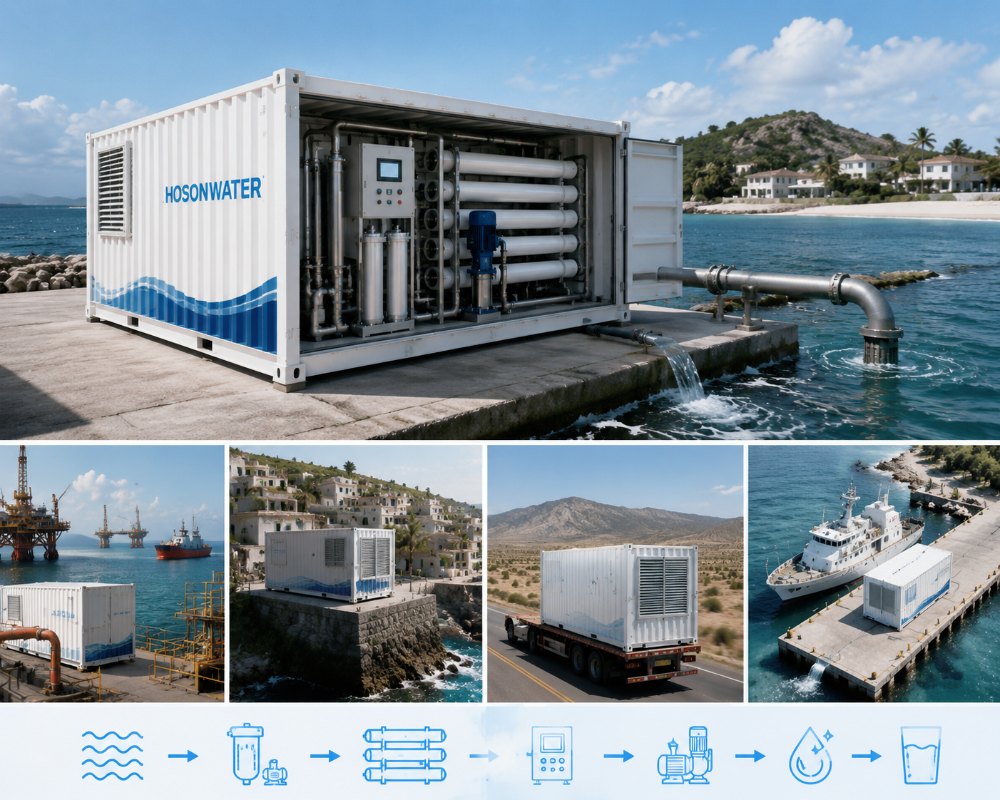
Containerization creates value by moving assembly, piping, electrical integration, and functional checks into a controlled factory environment. We can define one boundary for pretreatment, high-pressure pumping, RO membranes, instruments, controls, and post-treatment, while the owner defines intake, storage, foundations, utilities, and concentrate disposal. That division reduces open-ended work at a remote site, which is why containerized seawater desalination plant projects are strongest when interfaces are frozen before production.
The enclosure also has a cost. A container needs ventilation, drainage, corrosion protection, safe chemical storage, lighting, fire provisions, access around pumps and membranes, and lifting points that match the packed weight. Those items occupy space that a plant room may use more efficiently. Containerized desalination plants therefore earn their place through logistics and risk control, not through the assumption that every component becomes smaller or cheaper.
Containerized is not the same as container-shipped
A skid-mounted package placed in a shipping container is still a skid unless the container is engineered as the operating enclosure. The distinction affects ventilation, maintenance clearances, drainage, structural loads, and commissioning. We state the arrangement explicitly because buyers comparing seawater desalination plants can otherwise price unlike scopes. A true containerized unit operates within its designed enclosure; an indoor-rated skid needs a prepared building, while outdoor service requires explicit weather protection.
Compare Total Installed Risk, Not Equipment Price Alone
The commercial comparison should include civil work, local fabrication, installation supervision, temporary storage, crane access, weather delays, operator training, and the cost of a missed water-supply date. A conventional plant room may win where skilled contractors, materials, and utilities are readily available. A containerized seawater desalination plant may win on an island, remote coastal compound, mine, or temporary utility project where repeated mobilization is costly.
| Decision factor | Containerized unit | Conventional site build |
| Factory scope | High integration and pre-dispatch checks | More assembly and coordination on site |
| Transport | Defined module, but strict route and lifting limits | Loose equipment may be easier to split |
| Maintenance | Protected equipment, tighter access | More room, but site workmanship varies |
| Expansion | Add modules if headers and controls allow | Flexible layout if land and utilities allow |
A modular desalination plant also supports staged investment, but only if the first phase reserves hydraulic headers, electrical capacity, control addresses, product-water storage, and concentrate handling for later modules. Without those interfaces, adding capacity can require the same redesign as a conventional expansion. The value comes from planned repetition, not from placing unrelated packages side by side.
Technical Proof Matters More Than the Enclosure
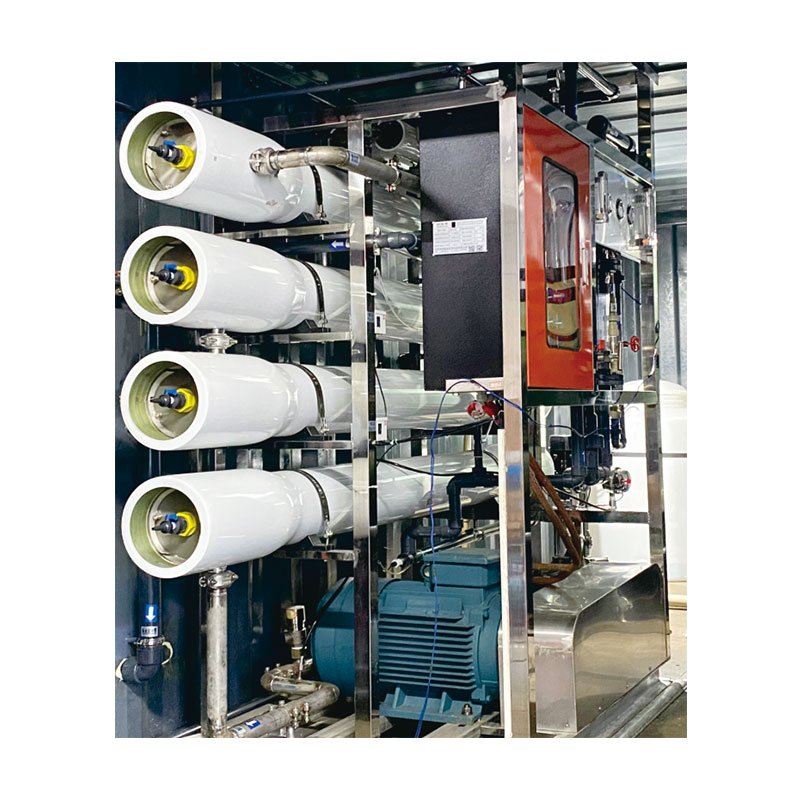
Performance must be tied to stated test conditions. For a pembangkit desalinasi modular, we define feed total dissolved solids (TDS), temperature, pH, product-water target, system recovery, operating pressure, installed power, voltage, pretreatment, and any energy recovery device.
The acceptance plan should separate equipment checks from water-quality performance. Factory acceptance testing can verify pressure integrity, instruments, alarms, valve sequencing, electrical protection, and the agreed test basis. Site acceptance testing must use the actual intake and confirm flow, recovery, permeate quality, operating pressure, leakage, noise, and operator handover. These records make comparisons between containerized desalination plants traceable instead of promotional.
Five inputs that can reverse the decision
- Seasonal feed TDS, turbidity, algae risk, temperature, and intake method.
- Daily and peak demand, required redundancy, storage, and future expansion.
- Power quality, allowable installed kW, fuel cost, and SEC test method.
- Road, port, crane, gross-weight, foundation, and unloading constraints.
- Local drinking-water limits, concentrate discharge permit, and laboratory responsibility.
Where the Business Case Usually Holds
The business case is strongest when water is operationally critical and the site cannot tolerate an extended construction program. Remote coastal communities, resorts, camps, and emergency assets often value a defined module, protected transport, and repeatable commissioning. Seawater desalination plants still need intake works, power, storage, and a permitted discharge route, so we never treat the container as a substitute for site engineering. We evaluate those balance-of-plant costs before recommending a containerized seawater desalination plant.
When a site-built arrangement can be better
A site-built arrangement can be better for very large capacity, permanent utilities with established contractors, unusual building codes, or sites where container transport is impractical. Containerized desalination plants can also be a poor fit when maintenance access is more valuable than relocation, or when high ambient temperature makes ventilation and cooling disproportionately complex. The right answer is conditional, not a universal endorsement.
Build the Schedule Around Interfaces
The schedule must separate manufacturing, freight, customs, site preparation, installation, commissioning, and training. Where our agreed project plan allows about 10 days for installation and commissioning after arrival, we keep that period separate from a freight cycle that may take around one month. Mixing them creates a false deployment promise. We also confirm whether piping, cables, chemicals, lifting, laboratory tests, and local permits are supplied by us or by the owner.
Send Us the Variables That Change the Answer
A useful enquiry gives us a recent water analysis, required m³/d, product-water limit, site coordinates, power standard, access route, discharge conditions, delivery term, packing needs, and required acceptance evidence. We can then compare the containerized option with a skid or site-built alternative and define exclusions clearly. A desalination system for sale should be reviewed against that project brief, not as an isolated equipment price. Review our sistem desalinasi untuk dijual options only after those project variables are fixed.
FAQ (Pertanyaan umum)
Do containerized units always cost less?
No. The equipment price may be higher because the enclosure needs ventilation, drainage, access, structural reinforcement, and corrosion protection. The saving appears when factory integration, lower site labor, fewer interfaces, and schedule certainty outweigh that premium.
How should buyers compare energy use?
Buyers should compare specific energy consumption in kWh/m³ at the same feed salinity, temperature, recovery, permeate target, and operating point. Installed motor power in kW is not a valid substitute for measured energy per cubic metre.
Can a containerized desalination unit be relocated?
Relocation is feasible when the design includes lifting points, preservation, drain-down, flexible interfaces, transport limits, and a recommissioning plan. Intake, storage, foundations, and discharge works usually remain site-specific.
What brine information is needed before purchase?
The buyer should define concentrate flow, salinity, chemical residuals, discharge location, mixing conditions, monitoring, and the responsible permit authority. Recovery alone does not prove that a discharge arrangement is acceptable.
What makes a desalination offer comparable?
A comparable desalination system for sale states the process boundary, test conditions, capacity, recovery, permeate limit, installed power, SEC method, voltage, dimensions, gross weight, packing, schedule, warranty scope, spares, training, and FAT/SAT responsibilities. Those fields also make seawater desalination plants comparable.