

A coastal water project can have the right treatment equipment and still miss its supply deadline because the site is unfinished. Containerized desalination units are worth considering when factory integration and phased capacity help control that risk. For project owners and engineering partners in Southeast Asia, Africa and the Middle East, their value depends on the complete supply scheme and its operating costs.
Factory Integration Changes the Work at the Site
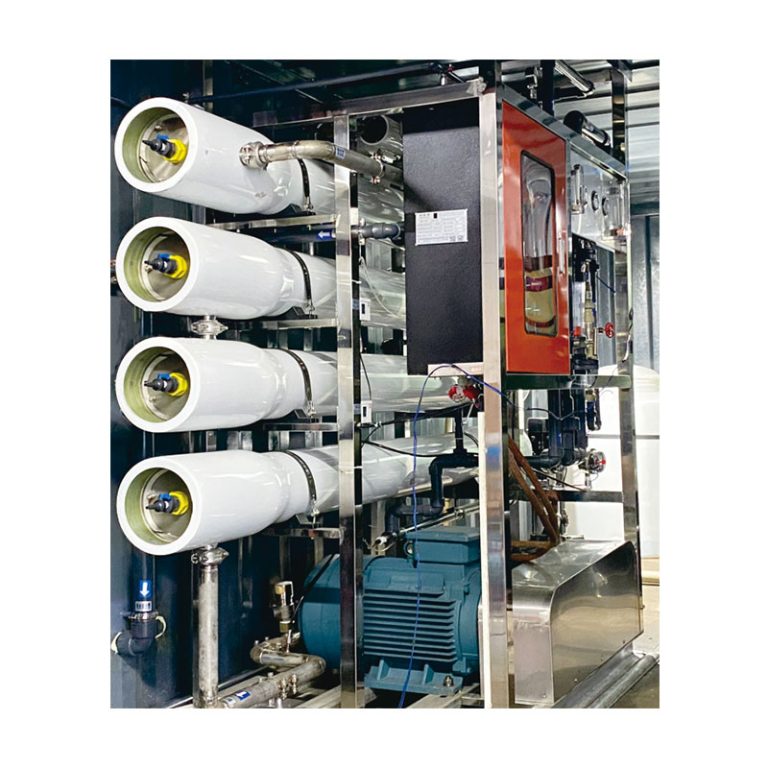
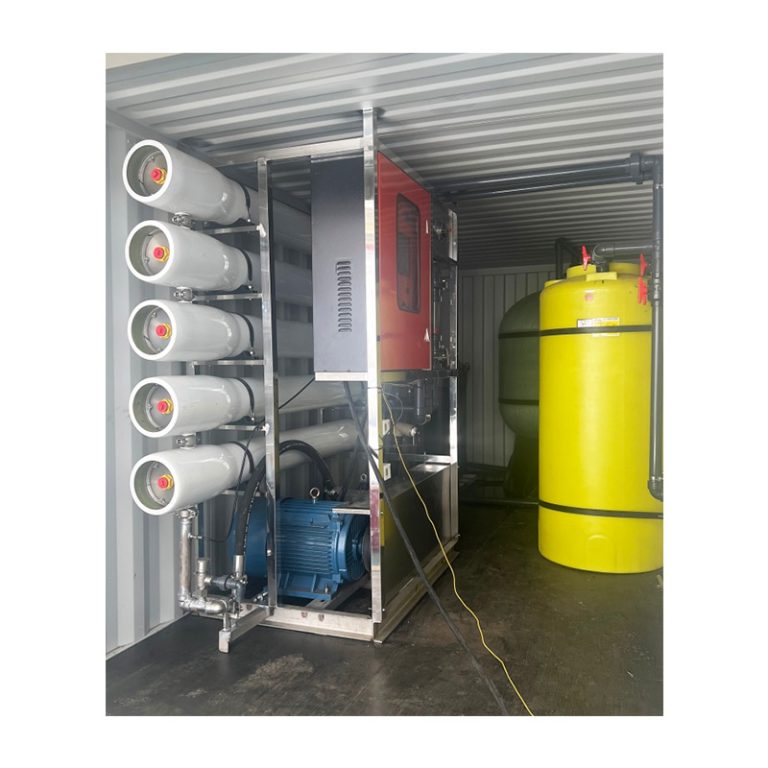
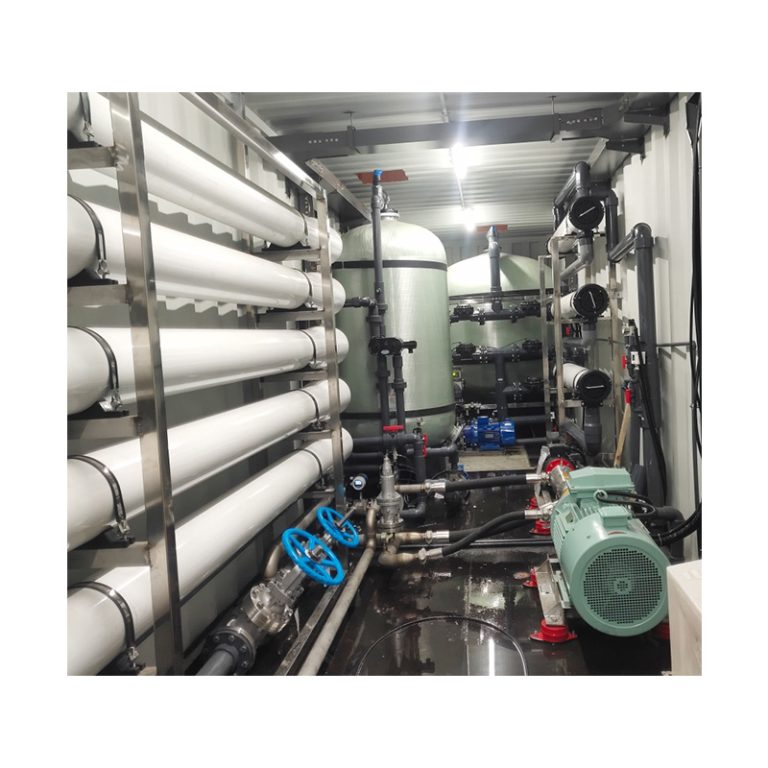
Containerized modular desalination units (CMDUs) bring integrated treatment equipment inside an enclosure. Pretreatment, seawater reverse osmosis (SWRO) and controls can be assembled before shipment, reducing the internal assembly work left for the site. A remote seawater desalination plant benefits when fewer connections need to be fabricated under local construction constraints.
The enclosure and the process skid are distinct parts of the delivery scope. A skid is an equipment frame; shipping it inside a container does not make it a complete CMDU. Ventilation, corrosion protection, maintenance access and external connections still need an integrated design. These details determine whether factory preparation translates into practical site advantages.
Coordinating design and testing is central to that transfer of work. HOSON WATER integrates customized desalination equipment and modular systems, with factory acceptance testing that includes a 48-72-hour continuous stability test. This checks operation under the agreed test conditions before dispatch. It does not establish performance across every seasonal feedwater condition.
Site Readiness Determines the Delivery Advantage
Factory completion is one milestone in a longer delivery schedule. Manufacture and testing, freight, customs, site preparation, installation and commissioning each require time. A short installation period after arrival cannot be presented as the full project lead time, particularly where ocean freight and inland transport are involved.
The site must provide the infrastructure that sits outside the container. Seawater intake and conveyance, suitable foundations, electrical supply, product-water storage and concentrate discharge remain part of the complete Meerwasser Entsalzungsanlage. Their scope and responsibilities should be settled early enough for site preparation to proceed alongside factory work.
The schedule advantage is strongest when these activities can run in parallel. If the intake or power connection remains unfinished, a delivered unit cannot provide the intended water supply. Comparing proposals therefore requires a common water-supply date and complete site scope, rather than equipment dispatch dates alone.
Capacity and Access Set the Practical Limits
Nominal output and equipment dimensions answer different planning questions. Output helps establish the production scale, while dimensions and mass affect positioning and handling. Two HOSON WATER reverse osmosis (RO) process units illustrate the distinction before project-specific enclosure integration.
| Modell | Nominal output (tonnes/day) | Equipment L x W x H (mm) | Approx. net mass (kg) |
| FSHB-100 | 100 | 5000 x 2000 x 1900 | 4500 |
| FSHB-150 | 150 | 5898 x 2352 x 2385 | 6000 |
Length, width and height describe the equipment itself. The figures are not packed shipping dimensions, complete container envelopes or total site footprints. The larger unit has a higher handling load and a different space requirement. Crane selection must use the final lifted assembly, including its enclosure and accessories where applicable.
Usable production needs a separate check against the intended operating conditions. Higher salinity or lower temperature can reduce output once available pressure reaches its limit. Confirm nominal capacity against the feedwater analysis and operating hours, then allow for shutdowns and water used by the treatment process when assessing water available to users.
Expansion depends on the common infrastructure as well as additional treatment units. A modular water treatment plant can support staged investment, but intake capacity, electrical supply, connecting pipework, storage and concentrate handling must accommodate the planned stages. Otherwise, another module may arrive before the site can use its capacity.
Cost per Usable Cubic Metre Resolves the Comparison
The economic comparison should cover the full water-supply system. Equipment price alone excludes costs that may determine whether containerization is worthwhile. Compare alternatives at the same water quality, delivered volume, operating period and site conditions, with consistent treatment of financing and replacement costs.
A practical cost model divides all-in annualized costs by annual water delivered for use. Include capital recovery, freight, installation, electricity, chemicals, membrane replacement, maintenance and operating labour. Account for treatment-process water use and downtime in the delivered-volume estimate. A unit operating well below its intended utilization spreads fixed costs across fewer cubic metres.
Energy figures must use a consistent measurement boundary. Power is expressed in kW; energy consumed over time is expressed in kWh. Plant specific energy consumption is measured electricity in kWh divided by usable water in cubic metres over the same period. Include relevant auxiliary loads when comparing complete supply schemes.
Containerization alone does not lower the energy needed for membrane separation. Feedwater conditions, process design and operation remain decisive. For sustained high-volume demand, compare a purpose-designed fixed plant on equivalent terms. Where demand grows in stages, custom water treatment equipment can help align the initial installation and later additions with the actual supply requirement.
When the Container Earns Its Cost
Containerized desalination is most compelling when reduced site assembly, constrained space or staged demand has measurable project value. The investment case weakens if incomplete infrastructure delays commissioning or low utilization leaves substantial capacity idle. The appropriate choice follows from a realistic delivery programme and cost per usable cubic metre.
For a coastal project, we can help compare the proposed process, enclosure and site interfaces against your water demand and source conditions. That assessment provides a practical basis for choosing the delivery format.
FAQ (häufig gestellte Fragen)
Are containerized units cheaper than fixed plants?
They can be, but the complete project determines the answer. Compare installed cost and lifetime operation at equivalent output and water quality. Lower site assembly costs do not automatically mean lower water costs.
Can a containerized unit provide permanent water supply?
Yes, if the installation is designed for its operating environment and service needs. Long-term operation requires maintenance access, trained operators, consumables and planned component replacement, even where remote monitoring is available.
How soon can water production start?
Production starts after the relevant site connections, commissioning and water-quality checks are complete. Freight and customs precede this work. A quoted commissioning period should specify its starting conditions and what it includes.
Does the container reduce electricity consumption?
The enclosure itself provides no membrane energy advantage. Compare measured or appropriately projected plant energy per usable cubic metre under matching feedwater conditions, including the auxiliary equipment within the agreed boundary.
What limits expansion or relocation?
Shared intake, power, storage and discharge capacity can constrain expansion. Relocation additionally depends on transport access and the receiving site’s infrastructure. The new location requires a fresh assessment of water conditions and commissioning needs.